Claude Duet: Anthropic's new AI agent that keeps working when you don't
Claude Duet watches your email, calendar and business apps, briefs you each morning and works in the background. How it works, what it costs, the catches.
Most AI assistants wait for you to open a chat and ask. Claude Duet, which Anthropic unveiled on 21 October 2026, flips that around. It keeps an eye on your email, calendar and business apps, tells you what needs attention each morning, and works through tasks in the background, then checks in before it does anything you can’t take back.
It’s aimed squarely at busy professionals and small-business owners, and it’s available now as a research preview with a waitlist. Here’s what it is, how it works, what it costs and what to watch out for.

What is Claude Duet?
Claude Duet is a proactive AI agent built on Anthropic’s Claude Opus 5.5 model. Anthropic’s one-line pitch is the difference between the two products: the regular Claude app waits for you to start a conversation, while Duet comes to you with a daily brief and updates on the work you’ve handed it.
It lives in its own app for iPhone and Android, and on the web at claude.ai. Everything happens in one continuous thread: you type or speak a task, it gets on with it, and it messages you when the job is done or when it needs a decision.
How it works
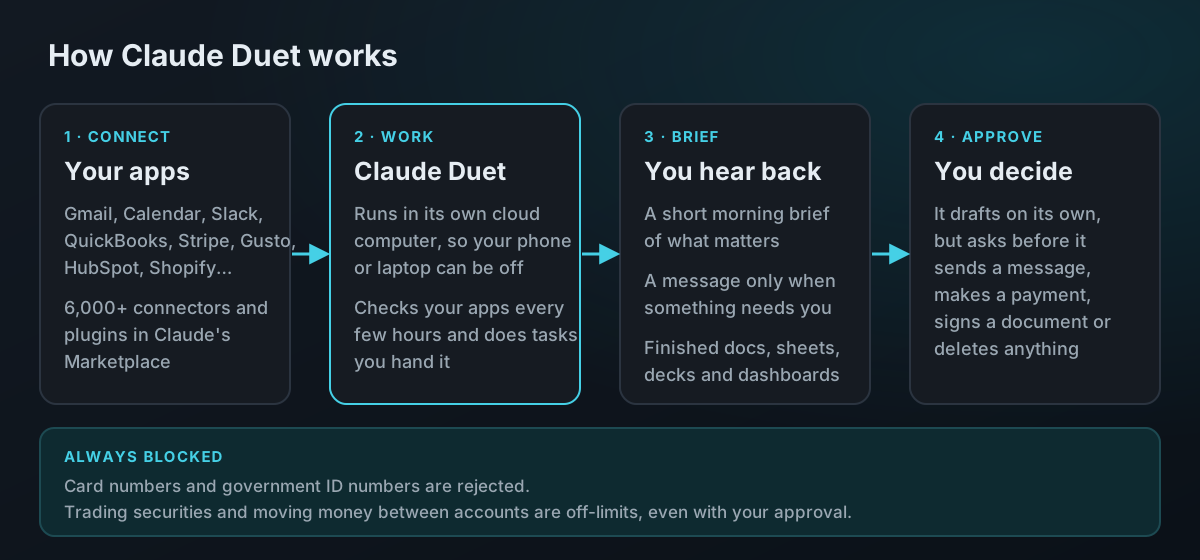
- It starts with what Claude already knows. Your memory, skills and connected apps carry over from your Claude account, so there’s no lengthy setup.
- It watches your apps. Duet plugs into the 6,000+ connectors and plugins in Claude’s Marketplace, including Gmail, Google Calendar, Slack, QuickBooks, Stripe, Gusto, HubSpot, DocuSign, Canva and Shopify. It checks them every few hours, and you choose what you want to hear about and how often.
- It sends a morning brief. Each day you get a short summary of the most important things across your apps. After that it stays quiet unless something genuinely needs you.
- It works in the background. Duet runs on its own cloud computer with its own browser, so your phone or laptop doesn’t have to stay on. You get a notification when a task is finished or ready for review.
- It asks before acting for you. It can read and draft freely, but before it sends a message, makes a payment, signs a document or deletes anything, it shows you exactly what it’s about to do and waits for your OK.
What can you actually hand it?
Anthropic’s examples are very much “running a small business” tasks:
- Spot Gmail and Slack messages you missed, and draft replies
- Find unpaid invoices in QuickBooks or Stripe and draft reminder emails
- Prepare payroll in Gusto for you to review
- Get contracts ready to sign through DocuSign
- Draft follow-up emails from your HubSpot deal history
- Schedule meetings, and build dashboards, forecasts, decks and spreadsheets
- Turn a product launch into a social campaign in Canva, or set up and run a Shopify store
Early testers quoted by Anthropic include an estate agent whose morning brief caught a property viewing booked on the wrong day, and a business owner with about 110 employees who uses it for invoices, accounting, marketing and customer support across his stores.
Privacy and safety: what it won’t do
Handing an AI access to your inbox and your accounts is a big ask, and Anthropic clearly knows it. The guardrails it describes:
- Some data is blocked outright. A dedicated classifier screens every message, and the most sensitive data, such as credit-card numbers and government ID numbers, is designed to be rejected. Other sensitive data, like health or personal-finance details, is shared only when you explicitly say so.
- It never sees your passwords. Credentials are handled so the agent doesn’t directly see passwords or sign-in tokens. When it buys something, it pays with a virtual card through Link (Stripe’s wallet), not your real card number.
- Some actions are off-limits even with approval, such as trading securities or moving money between accounts.
- Defences against prompt injection, where a malicious email or web page tries to trick the agent, are built on Anthropic’s browser-use research.
- Outside testing. Anthropic says red teams and an external security firm have tried to break it, and it’s covered by Anthropic’s public bug bounty.
- You can disconnect any app at any time.
One thing the launch pages don’t spell out is how long Duet keeps your data. If that matters for your business, read Anthropic’s privacy policy, linked below, before connecting work accounts.
Price and availability
- Who can get it: Claude Pro and Max subscribers in the US, through a waitlist. Anthropic emails you when it’s your turn. Team and Enterprise plans aren’t included yet.
- Cost: no extra charge during the preview. Pro is $20 a month ($17 a month billed yearly) and Max starts at $100 a month.
- The catch: Duet shares your plan’s usage limits. Its background check-ins count against them, and big jobs like a financial model or a deck use more, so heavy users may hit limits sooner.
- Outside the US: Anthropic hasn’t said when Duet will reach other countries, including India.
The limitations Anthropic admits
To its credit, Anthropic is upfront that this is a preview:
- It can misread a thread or misjudge how urgent something is.
- It can miss something that arrives between check-ins.
- Personal errands, like booking tickets, are less polished than work tasks.
- It can’t show you its browser yet, so you can’t watch it work.
- It’s a separate app from Claude for now, and Anthropic says early feedback will shape how the two fit together.
How does it compare?
Proactive AI is becoming a category of its own. OpenAI’s ChatGPT Pulse, launched in September 2025 for its $200-a-month Pro subscribers, also writes you a personalised morning briefing. Duet goes a step further: it doesn’t just brief you, it does the work, from chasing invoices to preparing payroll, inside the business apps you already use, with an approval step before anything goes out.
Should you sign up?
It’s worth a try if you’re a freelancer, consultant or small-business owner already paying for Claude Pro or Max, and your day is buried in email, invoices and scheduling. You lose nothing by joining the waitlist.
Be cautious if you handle sensitive client data or regulated information. Start by connecting only a couple of apps, read every approval request properly before tapping OK, and keep an eye on how quickly it uses up your plan.
Not yet for you if you’re outside the US or on a Team or Enterprise plan. You’ll have to wait.
The bottom line
Claude Duet is the clearest sign yet that AI assistants are moving from “answer my question” to “handle this for me.” The pitch is strong: a morning brief, background work on its own computer, and approval gates around anything risky. Anthropic is also unusually candid about the rough edges. It’s a research preview, so expect mistakes. For a busy professional, though, an assistant that catches the meeting on the wrong day or the invoice nobody chased could earn its place quickly.
New to AI agents? Start with our explainer on MCP, the protocol that lets AI connect to your apps.
Sources & further reading
- Anthropic — Introducing Claude Duet
- Claude Duet — product page and waitlist
- Claude — plans and pricing
- Anthropic — Prompt injection defenses
- Anthropic — Privacy policy
- CNET — Anthropic introduces Claude Duet, a new agentic AI app for professionals
- TechCrunch — OpenAI launches ChatGPT Pulse to proactively write you morning briefs
Keep reading
Plaud Note Pro: the credit-card AI recorder that writes your meeting notes
A credit-card-thin AI recorder that transcribes and summarises your meetings and calls. What the Plaud Note Pro does, what it really costs, and who should buy one.
Read more →
Claude Code vs. GitHub Copilot vs. Cursor: which AI coding tool actually fits your workflow (2026)
Claude Code vs GitHub Copilot vs Cursor: an honest, workflow-first comparison of pricing, models and real strengths, and who each AI coding tool is for.
Read more →
Elgato Stream Deck MK.2: the 15-button gadget that speeds up everything you do
15 tiny screen-keys that launch apps, run shortcuts and control your stream, calls and music in one tap. What the Elgato Stream Deck does and who it's for.
Read more →